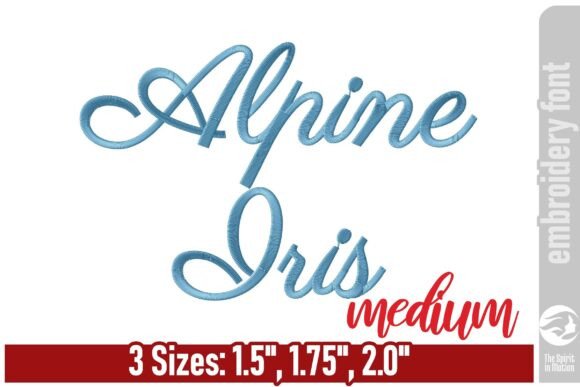
Alpine Iris Script Embroidery Font - M
Elegant, Upscale, and Instantly Recognizable
As an embroidery designer who’s prepped over 200 craft fair booths—and shipped thousands of embroidered tote bags, aprons, and tea towels—I opened Alpine Iris Script Embroidery Font - M expecting refinement. What I got was even better: a medium-weight satin script that feels quietly luxurious—not fussy, not fragile, but unmistakably high-end. It leans into elegance without sacrificing legibility or stitch efficiency. That’s rare. Most “premium” script fonts either sacrifice speed for flourishes or flatten into generic cursive. Alpine Iris Script Embroidery Font - M lands in the sweet spot: graceful curves, balanced spacing, and consistent letter weight—ideal for sellers who want their handmade product to whisper “curated,” not shout.
Where It Shines on Craft Fair Products
This isn’t a font for every surface—but where it *does* land, it elevates instantly:
- Tote bag design: Centered on natural canvas or heavyweight linen, Alpine Iris Script Embroidery Font - M reads beautifully at 3.5–4.5 inches wide—large enough to catch the eye from six feet away, small enough to keep proportion on a market bag.
- Apron embroidery: Perfect above the pocket or along the waistband. Its medium-weight satin stitching holds up against repeated washing and doesn’t snag on kitchen edges.
- Tea towel embroidery: Works best on smooth, tightly woven cotton (not terry or heavy waffle). A single name or short phrase—like “Brew & Bloom”—stitched in Alpine Iris Script Embroidery Font - M adds boutique-level polish without overwhelming the textile.
- Embroidered patch: Crisp, clean, and highly reproducible. Ideal for iron-on or sew-on patches sold as add-ons or bundled with handmade kits.
- Pillow covers & small pouches: At 2.75–3.25 inches wide, Alpine Iris Script Embroidery Font - M retains clarity and flow—even on curved seams or bias-cut fabric.
It’s less effective on baseball caps (curved crown distorts fine script flow) or dense, napped fabrics like fleece—unless you adjust density and stabilizer aggressively. And while it’s lovely on dark fabric, always test thread contrast: matte black thread on charcoal linen reads richer than glossy navy on navy.
What Makes It Sell—Beyond Pretty Letters
At a craft fair, attention is measured in seconds. Alpine Iris Script Embroidery Font - M wins because it’s instantly legible and emotionally resonant. Customers don’t squint—they pause, smile, and say, “That’s mine.” That emotional hook translates directly to booth engagement: more questions, more photo requests, more repeat buyers. It also strengthens brand consistency across your line—if your shop leans modern-rustic or botanical-luxe, this font becomes a quiet signature.
For Etsy sellers and digital embroidery file shops, Alpine Iris Script Embroidery Font - M photographs exceptionally well. Its satin sheen catches light without glare; its spacing avoids “crowded” or “sparse” traps common in script fonts. Pair it with soft natural lighting and a neutral background, and your printable mockup will convert browsers into buyers. Plus, because it’s optimized for high-speed stitch-out, batch production stays predictable—no mid-run thread breaks or needle jams derailing your deadline.
Careful-Use Notes Every Designer Should Know
Even elegant scripts have limits. Here’s what to watch for before cutting fabric:
- Small lettering: Avoid scaling Alpine Iris Script Embroidery Font - M below 2 inches wide—tiny terminals and hairline connections may collapse or lose definition, especially on textured towels or loosely woven cotton.
- Dense stitch areas: Look closely at overlapping loops (e.g., in “&”, “g”, or “y”). On thick stabilizer or heavy fabric, these can build bulk. Test with lightweight cutaway + tear-away combo.
- Fabric texture: Skip terry cloth, bouclé, or heavily brushed flannel unless you’re willing to over-stabilize and reduce stitch density manually.
- Dark fabric + light thread: Satin stitch reflects light differently on deep tones—always run a real mockup, not just a screen preview.
- Curved surfaces: Caps, curved pillow gussets, and tapered pouches require repositioning or digitized contour compensation—Alpine Iris Script Embroidery Font - M wasn’t built for automatic wrap-around.
Real-World Designer Prep Checklist
Before committing to 50 tote bags or listing on Etsy:
- Test the embroidery file on scrap fabric matching your final product—same weave, weight, and dye lot.
- Check thread colors against your fabric swatches under both daylight and booth lighting.
- Review letter spacing—especially for names or monograms—to avoid unintended gaps or collisions.
- Confirm hoop size compatibility; Alpine Iris Script Embroidery Font - M fits standard 4×4 and 5×7 hoops at recommended sizes.
- Inspect stitch density visually—no muddy fills, no skipped sections, no floating threads.
- Use appropriate stabilizer: medium-weight cutaway for stretchy knits, tear-away + light cutaway for stable wovens.
- Create at least one finished product mockup—not digital, not printed, but stitched, washed, and pressed.
- Compare how it looks across multiple fabric colors—cream, oat, slate, and black tell very different stories.
- Verify commercial licensing terms before selling finished products—this is essential for any small shop product or commercial embroidery business.
Final Thought: A Quiet Confidence That Converts
Alpine Iris Script Embroidery Font - M doesn’t chase trends. It supports them. It gives your handmade product authority without arrogance, charm without clutter, and luxury without pretense. In a sea of bold block fonts and playful doodles at the craft fair, it stands out by being simply, confidently *refined*. That’s why it works so well for boutique makers, Etsy sellers building long-term brands, and embroidery business owners who know that great Sewing and Embroidery design isn’t about complexity—it’s about resonance, reliability, and repeatable beauty. Use it wisely, test thoroughly, and let it do what it does best: make your customer feel seen, valued, and quietly delighted.