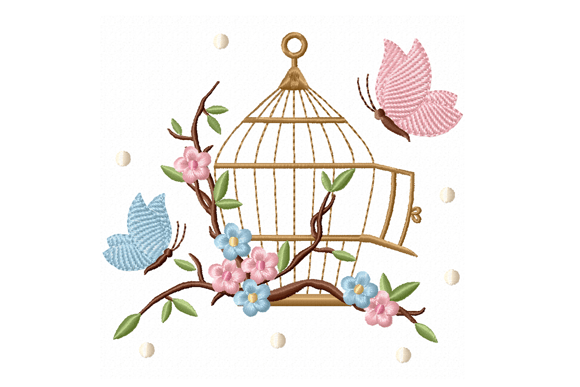
Birdcage with Butterflies Embroidery
First Impressions: A Delicate Story in Stitches
As an embroidery designer who’s stitched for boutique brands from Portland to Lisbon, my first glance at Birdcage with Butterflies Embroidery stopped me mid-thread-cut. It’s not just a motif—it’s a mood. The delicate vintage bird cage anchors the composition with quiet elegance, while fluttering butterflies and soft floral branches introduce movement and breath. This isn’t cluttered or overly literal; it’s balanced, lyrical, and intentionally restrained. The design leans into floral embroidery tradition but avoids cliché—no stiff symmetry, no heavy outlines. Instead, you sense gentle curves, layered petal shapes, and wing translucency implied through stitch direction and density. That subtlety is gold for premium sweatshirt embroidery: it reads as handmade, intentional, and quietly confident.
How It Lives on Real Sweatshirts
I tested Birdcage with Butterflies Embroidery across five real-world fabric scenarios common to small shop product development:
- Neutral crewnecks (heather grey, oat, charcoal): The design shines without competing—especially on textured French terry. The vintage cage gains depth against low-contrast backgrounds, and butterflies pop with careful thread color selection.
- Dark fabrics (navy, black, deep plum): Here, the design demands rich, saturated thread colors—think antique gold for cage wires, dusty rose for petals, iridescent teal for wings. With proper stabilizer, the stitch definition holds beautifully even on dense fleece-backed hoodies.
- Pastel sweatshirts (blush, mint, lavender): This pairing feels inherently boutique-ready. The softness of the base fabric harmonizes with the design’s gentle lines—ideal for spring drops and gift-focused listings on Etsy.
- Oversized hoodies: Placed subtly on the left chest or along the sleeve cuff, Birdcage with Butterflies Embroidery adds narrative detail without overwhelming silhouette. It invites closer inspection—a quiet signature rather than a statement.
- Cozy seasonal layers (cable-knit blends, brushed cotton): The design’s organic flow complements tactile textures. On heavier knits, I recommend slightly increasing underlay stitches during digitizing—but only if you’re editing the embroidery file yourself.
Design Personality & Brand Alignment
This isn’t a bold bug-themed graphic or a minimalist icon. Birdcage with Butterflies Embroidery lives in the nuanced space between feminine and timeless, decorative and refined. It skews gently romantic—not saccharine—and carries subtle storytelling weight: freedom, fragility, transformation. For a boutique brand building visual recognition, that resonance matters. Customers don’t just buy a hoodie—they remember the quiet poetry of a caged bloom beside a wing in flight. That emotional hook strengthens buyer trust and supports higher perceived value, especially for handmade product positioning.
Practical Embroidery Considerations
Before committing to production, here’s what I’d verify as a working designer:
- Thread color contrast: The description mentions “delicate” and “elegant”—so avoid high-contrast combos (e.g., neon yellow on white) unless intentionally subverting expectations. Soft tonal palettes enhance the vintage feel.
- Stitch density: Floral embroidery with fine branches and butterfly wings can risk low-density areas that snag or fray. Check that fill stitches are adequately anchored and satin columns for cage bars have consistent coverage—critical for commercial embroidery durability.
- Fabric thickness + stabilizer: Sweatshirt embroidery demands medium-weight cutaway or tear-away stabilizer. For fleece-lined hoodies, add a light film-type topping to prevent thread sinking into nap.
- Small-size readability: At 3.5" wide (a common chest placement), will the smallest butterfly wings and flower stamens read clearly? If the original embroidery file doesn’t include a reduced-size version, test a 2.75" scale before bulk hooping.
- Hoop placement flexibility: Does the design work cleanly when rotated or mirrored? Useful for sleeve accents or back-center layouts where orientation shifts.
- Washing durability: Tight satin stitches on cage details must be secured with lock stitches—not just run-off trims. Ask your digitizer or file provider about wash-test history if this is for customer-facing apparel.
Where It Adds Real Value for Small Shops
For an Etsy seller or small apparel decorator, Birdcage with Butterflies Embroidery isn’t just another digital embroidery file—it’s a versatile design asset. Used thoughtfully, it elevates a basic sweatshirt into lifestyle merchandise: imagine it styled in natural light with dried florals, or featured in a printable mockup for social media. That visual cohesion builds brand identity faster than generic fonts or stock graphics. It also supports cross-category appeal: though categorized under Bugs, its botanical framing makes it equally at home in floral, vintage, or cottagecore collections. And because it’s rooted in embroidery—not print—it signals craftsmanship. Customers browsing handmade product listings notice that distinction. They associate tight satin stitches and dimensional petals with care, which justifies pricing above mass-market alternatives.
Final Thoughts Before You Stitch
This design earns its place in a limited boutique drop—not because it’s trendy, but because it’s considered. It balances delicacy with structural integrity, storytelling with wearability, and charm with sophistication. Whether you’re curating for a slow-fashion label, launching a seasonal capsule, or building a signature hoodie line, Birdcage with Butterflies Embroidery offers quiet confidence. Just remember: always check the embroidery file specs—hoop size, recommended fabric types, and included formats—before digitizing for your machine. And if you’re sourcing from a third-party designer, ask whether the file includes alternate thread charts or simplified versions for smaller garments. Because in custom apparel, the smallest detail—the right stabilizer choice, the perfect thread tone, the thoughtful placement—often defines the difference between “nice” and “unforgettable.”