Black Floral Cat Embroidery Design
First Impression: Gothic Whimsy That Stops Shoppers in Their Tracks
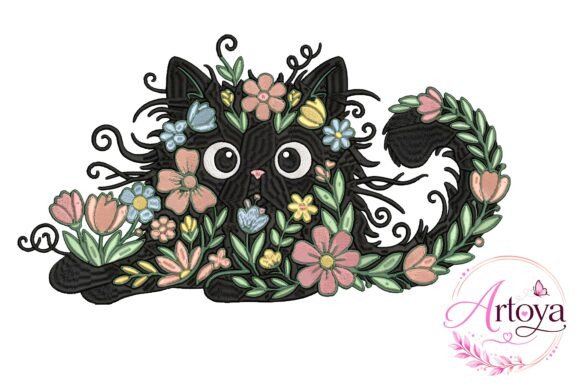
As an embroidery designer who’s prepped over 200 craft fair booths—and watched real customers pause, lean in, and ask “Where did you get that?”—I can tell you this at a glance: Black Floral Cat Embroidery Design delivers instant mood. It’s not cutesy or generic. It’s bold but balanced—gothic enough to stand out among farmhouse florals and minimalist linens, yet whimsical and approachable thanks to the botanical curves and expressive kitty silhouette. Customers don’t just see “a cat.” They see character: mysterious, elegant, quietly playful. That emotional hook is gold for handmade markets—especially when your booth is packed with similar-sized tote bags and tea towels.
Where This Design Truly Shines on Craft Fair Products
This isn’t a one-size-fits-all embroidery file. Its strength lies in intentional placement and thoughtful product pairing:
- Tote bag design: Centered on a natural canvas or black linen tote, Black Floral Cat Embroidery Design reads as premium—not busy, not childish. The contrast between matte fabric and dense floral stitching creates tactile depth that photos rarely capture (but shoppers feel).
- Apron embroidery: Perfect above the pocket or centered on the bib. The vertical flow of stems and petals echoes apron lines, while the cat’s profile adds personality without overwhelming utility.
- Tea towel embroidery: Works best on medium-weight cotton or linen-look towels—not terry. Avoid dense weaves; stitch definition suffers. A single placement near the hem (not corner) keeps it visible when hung or folded.
- Embroidered patch: Highly viable—if digitized with clean underlay and reduced fill density. Ideal for denim jackets, market bags, or kids’ backpacks. Test stitch a 3” version first: tiny stamens or petal edges may blur if scaled too small.
- Pillow cover & fabric pouch: Excellent focal point. The gothic botanical theme elevates otherwise simple shapes—making them giftable, Instagrammable, and booth-worthy.
What Holds It Back (And How to Fix It)
Let’s be honest: not every product is a fit. Here’s where caution saves time, thread, and reputation:
- Caps & curved surfaces: The cat’s facial details and tight flower clusters struggle on structured caps unless professionally hooped and stabilized. Skip unless you’ve tested on scrap with your exact cap brand and curve radius.
- Dark fabric: “Black” in the title refers to the cat—not background fabric. On charcoal or navy, thread contrast vanishes unless you use bright white, silver, or metallic thread. Always test thread colors against your base fabric before batch production.
- Textured towels: Heavy waffle or terry weaves swallow fine stitches. If using for kitchen goods, choose flat-weave cotton or linen blends—and double up tear-away stabilizer.
- Small-scale applications: Below 3.5”, delicate stems and inner cat markings lose clarity. Use only as a large focal (4–5”) or simplify key elements for patches or labels.
Production Reality Check for Small Shop Owners
This machine embroidery design rewards preparation—not guesswork. As someone who’s scrapped three dozen test runs before a Saturday market, here’s my non-negotiable checklist:
- Test on scrap fabric matching your final product—same weight, weave, and dye lot.
- Confirm hoop size before cutting dozens of pieces. Does it fit your standard 5x7? Or does it push into 6x10 territory? That changes your workflow.
- Inspect stitch density in floral centers and cat fur areas. High density = more thread, longer run time, and higher risk of puckering on lightweight fabrics.
- Use the right stabilizer: Cutaway for knits and stretchy pouches; heavy tear-away for tea towels; fusible + tear-away for lightweight linens.
- Create at least one real mockup—not just a printable mockup. Drape it. Hold it in natural light. See how shadows fall across petals. That’s how you spot what looks “off” in person but perfect online.
- Compare fabric colors side-by-side: black cat on cream vs. oat vs. slate gray tells completely different brand stories.
- Confirm commercial licensing before selling finished products. This is a digital embroidery file—not public domain. Verify usage rights for your Etsy seller shop, wholesale line, or boutique consignment.
Why It Moves Product—Beyond Aesthetics
In a crowded handmade market, Black Floral Cat Embroidery Design does more than look good—it builds perception. It signals intentionality (not just “cute cat”), craftsmanship (dense botanical layers read as skilled digitizing), and niche appeal (gothic + botanical + feline = loyal collector energy). When placed on a well-made tote or pillow cover, it lifts perceived value—justifying a $38 price point instead of $28. In your booth display, it draws eyes away from mass-produced prints and toward hand-finished texture. And for Etsy sellers? It’s highly searchable: “gothic cat embroidery,” “botanical kitty pattern,” “black floral embroidery”—all align with real buyer intent.
Final Designer Note: Charm Needs Clarity
That “magical gothic charm” promised in the description only lands if execution honors the design’s balance. Don’t rush contrast checks. Don’t skip stabilizer tests. Don’t assume a 4” version will translate cleanly to a 2.5” patch. Every stitch in Black Floral Cat Embroidery Design was placed to serve mood and legibility—not just fill space. Respect that. Your customers will feel it in the drape of the fabric, the weight of the thread, and the quiet confidence of a handmade product that doesn’t shout—but still gets chosen first.