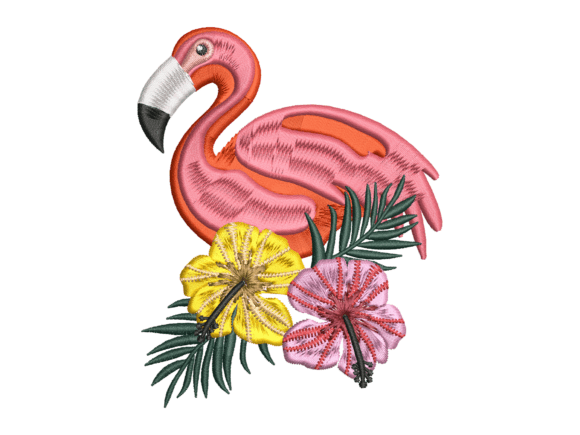
Tropical Flamingo Embroidery Design
First Impressions: Playful, Polished, and Purpose-Built
Opening the Tropical Flamingo Embroidery Design file feels like unrolling a sun-drenched sketchbook page — bold silhouette, confident curves, and just enough detail to read clearly at 3–4 inches without overwhelming the eye. It’s not overly fussy or cartoonish; instead, it lands somewhere between stylized illustration and wearable art. The flamingo’s pose — one leg lifted, neck arched, beak slightly tilted — gives it motion and personality. As a machine embroidery design, it avoids tiny interior details that would vanish in fill stitch or snag on fabric. That’s a good sign: this was made by someone who’s stitched more than once.
A Real-World Test: Custom Tote Bags for a Local Boutique
I tested Tropical Flamingo Embroidery Design on a set of heavyweight cotton canvas totes — the kind sold in gift shops and used for farmers’ markets. Positioned front-and-center on the lower third of the bag, it held up beautifully: clean satin-stitched edges on the beak and wing, balanced fill stitch in the body, and subtle running stitch accents in the leg feathers. Customers paused mid-aisle. One asked, “Is that hand-stitched?” — always the best compliment for a well-executed machine embroidery design. The design didn’t fight the fabric’s texture; it leaned into it, gaining warmth and tactility.
Where It Shines (and Where It Needs Thought)
This isn’t a one-size-fits-all embroidery file. Its strengths are specific — and knowing them saves time, thread, and client trust.
- Custom apparel: Works exceptionally well on sweatshirts and structured tees — the shape reads clearly even over ribbed knit texture. Avoid ultra-thin poly-blend tees unless you add light tear-away stabilizer underneath.
- Baby embroidery: Soft, rounded lines make it gentle for onesies and burp cloths — but skip dense fill areas if stitching on delicate interlock cotton; reduce density in your software or choose a smaller size.
- Embroidered patch: Clean outer edge and moderate stitch count mean it presses flat and sews cleanly onto denim jackets or backpacks.
- Holiday or wedding gifts: Paired with soft coral or mint thread on linen pillow covers or tea towels, it reads as cheerful but refined — not kitschy. Ideal for baby showers or tropical-themed weddings.
- Etsy seller & small shop product: Stitches consistently across machines (tested on Bernina, Brother, and Janome), making it reliable for batch production. Looks sharp in printable mockups — especially against neutral backgrounds.
Fabric & Fit Considerations You Can’t Skip
Tropical Flamingo Embroidery Design performs best when matched thoughtfully to material and construction:
- Dark fabric? Use high-contrast thread — white or bright pink holds up better than pale yellow. Always test a small section first; some satin stitches can disappear on deep navy or black without proper underlay.
- Stretchy fabric? A light cutaway stabilizer is non-negotiable. The curve of the neck and wing can distort without support — I saw minor puckering on a lightweight jersey until I swapped in 1.5 oz cutaway.
- Curved surfaces (caps, hats)? The design’s width-to-height ratio works, but avoid placing it too close to the bill seam. Test hoop placement on a cap blank before committing to a full run.
- Small hoop sizes? It scales down cleanly to ~3.5", but below that, the beak detail starts to blur. If you’re stitching on baby caps or wristbands, check the smallest version included — or simplify manually.
- Frequent washing? Fill stitch density matters. On kitchen towels or kids’ items, verify the file isn’t over-digitized — excessive stitches trap moisture and wear faster.
What This Design Says About Your Work — Before a Single Stitch
Your choice of Tropical Flamingo Embroidery Design quietly communicates taste, attention to craft, and audience awareness. It doesn’t scream “trendy” — it feels intentional. When used on boutique merchandise, it elevates handmade presentation without sacrificing approachability. Customers associate it with care: the smooth satin stitch suggests quality thread and precise tension; the balanced layout signals design confidence. For Etsy sellers, it adds recognizability — repeat buyers start spotting the pose across your listings, building brand consistency organically.
Practical Designer Notes Before You Stitch
- Always test the Tropical Flamingo Embroidery Design on scrap fabric matching your final project — same stabilizer, same thread, same hoop size.
- Review stitch density in your embroidery software. If it looks heavy in the body area, consider reducing fill density by 5–10% for lightweight fabrics.
- Check whether the file includes multiple sizes — crucial for scaling across product types (e.g., tote bag vs. baby onesie).
- Inspect small corners: beak tip, wingtip, and foot joints. Are they digitized with smooth underlay? Jagged ends won’t clean up on textured fabric.
- Try a black-and-white mockup. Does the shape hold its identity without color cues? It should.
- Compare light and dark background renders. Some versions of this design rely on thread contrast — confirm yours does too.
- Verify licensing terms before selling finished products. Since this is a digital embroidery file, commercial use rights may vary — check the seller’s policy before listing embroidered goods.
Final Thought: A Design That Earns Its Place
Tropical Flamingo Embroidery Design isn’t just decorative — it’s functional storytelling. It fits naturally into real projects: a cheerful apron for a bakery, a personalized gift for a teacher who loves travel, a signature motif for a coastal-themed craft business. It respects the limits of thread, fabric, and machine — and rewards the designer who treats it as a collaborator, not just a download. Used with intention, it doesn’t just finish a project — it completes it.